For decades, Americans have been assured that two of the world’s most controversial chemicals are “safe in small amounts.” One is fluoride, intentionally added to public water supplies to prevent tooth decay. The other is glyphosate, the main ingredient in the herbicide Roundup®, used on everything from corn and soy to suburban lawns.
Yet almost no one has asked the most important question: what happens when these two chemicals meet?
It turns out they form a partnership that neither regulators nor the public fully understand. Once they come into contact with a common third player, aluminum, the trio can create a complex molecule that alters how the body performs some of its most fundamental biochemical tasks.
1. Two Everyday Chemicals With Hidden Interactions
- Fluoride is a highly reactive halogen. The form added to drinking water (as hydrofluorosilicic acid or sodium fluoride) is industrially derived rather than mined from natural mineral sources.
- Glyphosate is a synthetic amino acid derivative designed to kill plants by disrupting a pathway that humans supposedly “do not have.” But our gut microbes do depend on that pathway, and so do our mitochondria through similar enzymes.
Each chemical on its own is already contentious. But when fluoride and glyphosate interact with aluminum, something new emerges: a ternary complex that behaves like a phosphate imposter in the body.
2. The Chemistry Simplified
In the presence of aluminum (Al³⁺), fluoride (F⁻) and glyphosate bind tightly to form a stable molecular structure known as an Al–F–Glyphosate complex. This can occur in acidic soils, water pipes, or inside living tissue.
Biochemically, this complex mimics phosphate, a fundamental molecule used in energy transfer (ATP), DNA, and numerous cellular signaling processes. The body cannot easily distinguish between true phosphate and this imitation.
When that happens, enzymes responsible for energy metabolism, hormone regulation, and neuronal activity can become confused. They may remain permanently switched “on” or “off,” misfiring the delicate systems that keep metabolism and brain function stable.
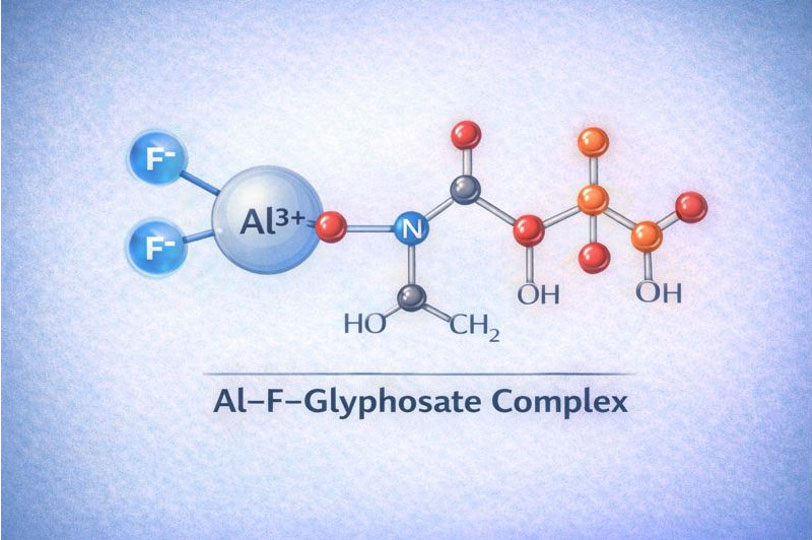
A simple labeled model showing aluminum bridged to two fluoride ions and the glyphosate structure, illustrating the phosphate-like geometry.
3. Why This Matters Biologically
When these complexes form, they are small enough and neutrally charged enough to cross protective membranes including the blood–brain barrier. Their phosphate-like geometry allows them to enter brain tissue, thyroid cells, and kidneys through natural phosphate transport channels.
The result can include:
- Energy metabolism fatigue through disruption of ATP synthesis
- Neurological stress from interference with nerve signaling enzymes
- Thyroid suppression, because fluoride and glyphosate both block iodine uptake
- Reduced detoxification capacity as the kidneys struggle to excrete the complex
In laboratory systems, aluminum–fluoride molecules are already known to mimic phosphate so precisely that scientists use them experimentally to “freeze” enzymes in active states. Imagine that happening not just in a Petri dish, but inside living human cells.
4. The Environmental Equation
This chemical combination is not exotic. It appears wherever three modern conditions overlap:
- Widespread glyphosate application on crops and lawns
- Municipal water fluoridation
- The presence of aluminum, from cookware, processed food additives, geoengineering, or the soil itself in acidic regions
These elements coexist in most industrialized settings.
Across the United States, approximately 73 to 74 percent of residents served by community water systems (over 200 million people) drink fluoridated water each day.
Regional contrast is striking: https://www.usnews.com/news/best-states/articles/2024-12-06/map-fluoride-in-drinking-water-by-state:
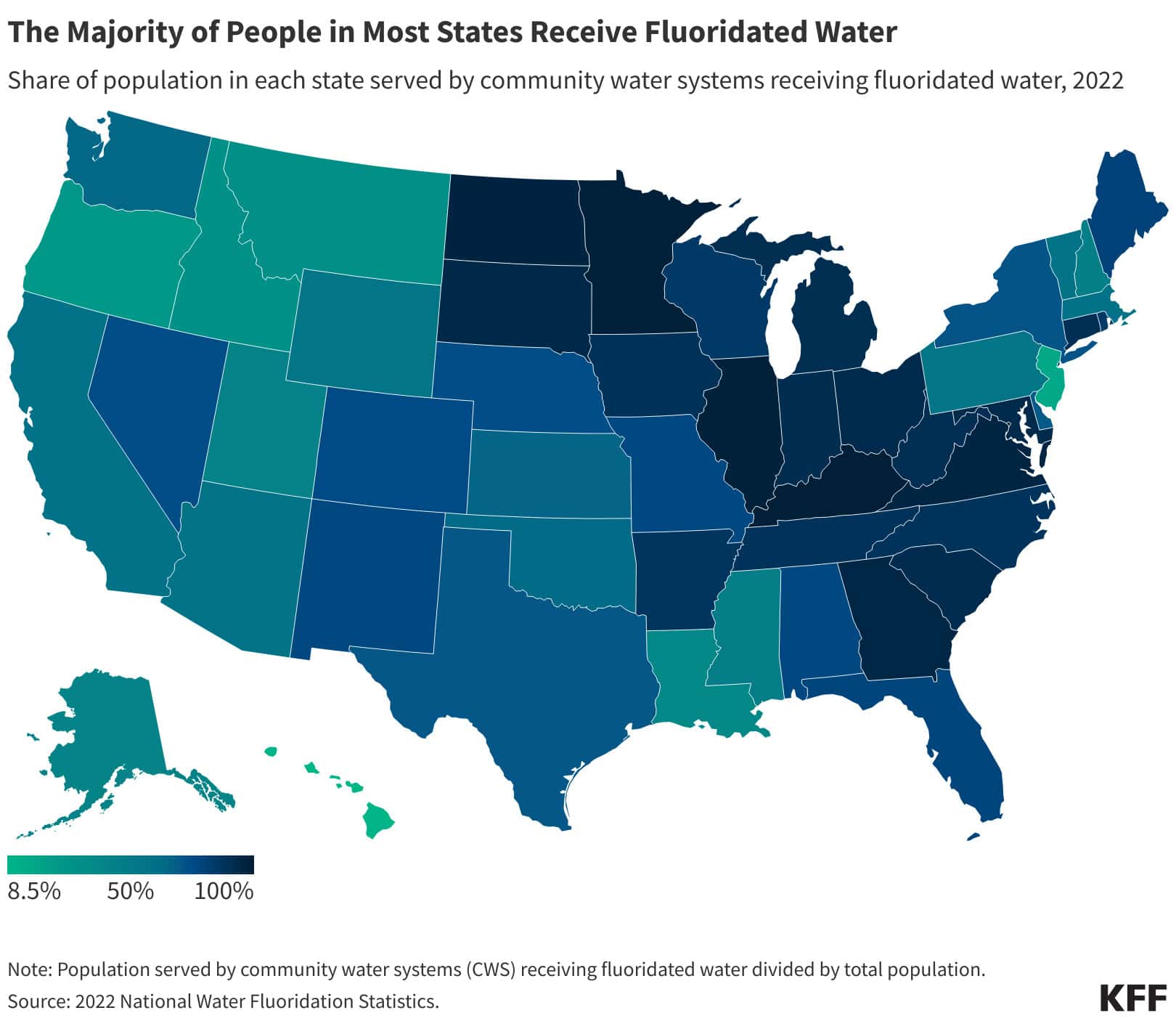
- Kentucky, West Virginia, Illinois, and Georgia maintain fluoridation rates above 95 percent.
- Hawaii, Oregon, Utah, and much of Florida remain largely unfluoridated.
- In May 2026, the State of Florida formally banned community-water fluoridation, joining Utah in rejecting the practice after state‑level health reviews cited safety uncertainties and escalating infrastructure costs.
5. The Human Cost of Chemical Complacency
Our regulatory framework still evaluates each compound in isolation. Pesticide agencies examine glyphosate. Dental-health agencies examine fluoride. Environmental divisions handle aluminum. No one studies what happens when all three combine in the bloodstream of a child.
This siloed approach blinds policymakers to chemical synergy which is the way molecules can amplify each other’s effects even at low levels. The emerging evidence on Al–F–Glyphosate complexes suggests that chronic low-dose exposure may produce subtle, but widespread biological stress, especially in infants, developing children, and those with impaired renal filtration.
6. Reducing Exposure Naturally
While we wait for regulators to catch up with reality, individuals can take protective steps:
- Filter your water thoroughly. Reverse osmosis or activated‑alumina systems remove fluoride and aluminum together.
- Choose food consciously. Glyphosate residues cluster in non‑organic grains, legumes, and oats; select certified organic regenerative food when possible.
- Rebuild mineral balance. Adequate calcium and magnesium help keep fluoride from binding to aluminum or displacing essential ions.
- Strengthen antioxidant defenses. Nutrients such as vitamin C, selenium, and plant compounds like turmeric and moringa counter oxidative stress.
7. A Broader Perspective
The story of fluoride and glyphosate is about more than chemistry. It reflects a mindset that treats human biology as a controlled experiment and assumes small exposures are harmless. But the data suggest that “safe in isolation” does not equal “safe in combination.”
Public health advances will depend on reframing how we assess environmental mixtures. A truly protective policy must look at interactions, not averages.
Final Thought
The Al–F–Glyphosate complex should be a wake‑up call. It proves that familiar chemicals can combine in unexpected ways inside the human body. The stakes are high because these molecules touch the most basic functions of life; how cells make energy, how nerves communicate, and how the brain develops.
Clean water and uncontaminated food are not privileges. They are prerequisites for civilization itself.
Understanding the chemistry is only the first step. Acting on it is the next.
At GMOScience, we turn complex research into understandable, digestible bites with the goal of empowering parents with science‑based insight to protect children and create a healthier now.