Note: A group of concerned scientists, physicians, educators, and authors have just published a peer-reviewed article regarding genetically modified microbes. Below is a summary of our work.
Five Key Takeaways (For Busy Readers)
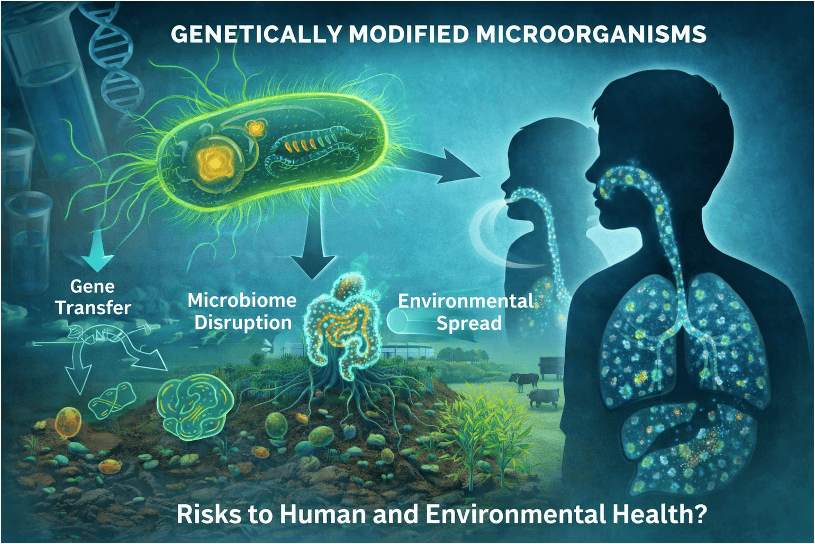
- Genetically modified microorganisms (GMMs) are living, self-replicating entities and not static chemicals. They can mutate, spread globally, and exchange genes with native microbes, creating risks that differ fundamentally from traditional GM crops.
- Human microbiomes (gut, oral, and infant) may be vulnerable. Engineered microbes could disrupt immune development, alter metabolism, encourage horizontal gene transfer, or contribute to inflammatory and autoimmune processes.
- Soil and climate systems are at stake. Soil microbes regulate nutrient cycling and carbon sequestration. Releasing GMMs at scale could destabilize these systems or accelerate the emergence of microbial “”
- Current US regulations treat many GMMs like industrial chemicals. Oversight is fragmented, short-term, and in many cases minimal especially for gene-edited microbes without foreign DNA.
- We call for precaution, rigorous pre-release assessment, and continuous post-release monitoring. Once living engineered microbes are released, they cannot simply be “recalled.”
What our new paper means for families, food systems, and policy
Modern biotechnology isn’t just about genetically engineered crops anymore. Increasingly, the “engineered product” is a living microbe; a bacterium or fungus designed to do a specific job: improve agriculture, make food additives or enzymes, reduce livestock methane emissions, break down waste, or even deliver medical therapies.
In our recent paper in Microorganisms, we examine an uncomfortable but necessary question: What happens when genetically modified microorganisms (GMMs) move beyond the lab and enter real ecosystems including the human microbiome?
This matters because microbes don’t behave like inert chemicals. They replicate, adapt, exchange genes, and interact with complex microbial communities that support digestion, immunity, metabolism, and healthy development, especially in children.
The key idea in plain language
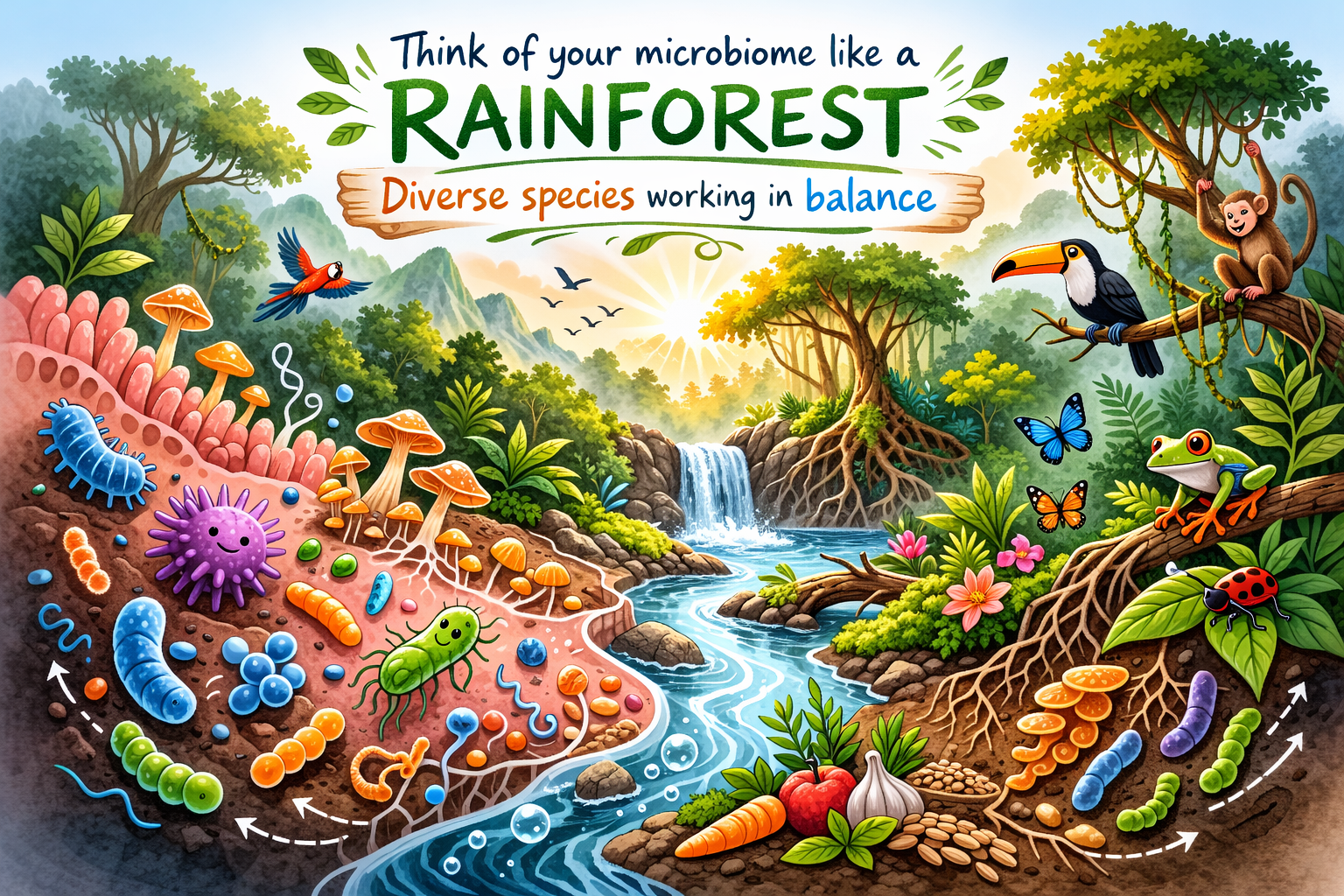
Think of your microbiome like a rainforest: diverse species working in balance. Introducing a new organism especially one engineered for a trait like “competitive advantage,” high output of an enzyme, or survival in harsh conditions can act like introducing an invasive species. Sometimes nothing dramatic happens. But sometimes it shifts the ecosystem in ways we don’t predict until later.
Our paper lays out risk scenarios that deserve more attention before engineered microbes are widely deployed in food systems, agriculture, and the environment.
What could go wrong?
1) Gene swapping: microbes can share DNA
Bacteria are famous for “horizontal gene transfer”; a microbial version of swapping software. That means engineered genetic traits (or nearby genetic elements) could, in certain settings, move into other microbes.
Why do families care? Because the gut and oral microbiomes are dense microbial ecosystems where gene exchange can occur, and because some transferred traits (depending on what’s engineered) could plausibly affect virulence, toxin production, or antibiotic resistance.
Bottom line: engineered microbes aren’t always “contained” by geography once they’re released.
2) Microbiome disruption (gut + oral)
Your gut and mouth are not sterile tubes; they’re living ecosystems that help train immune tolerance, support barrier integrity, and metabolize nutrients and xenobiotics.
A genetically modified microbe could:
- displace beneficial organisms,
- alter microbial “outputs” (metabolites),
- change how the immune system interprets what’s safe vs. threatening,
- contribute to dysbiosis in vulnerable people.
This is especially relevant for children, whose microbiomes and immune systems are still developing, and who are more sensitive to environmental inputs.
3) Immune signaling: new proteins can act like new exposures
Engineered microbes may produce proteins/enzymes at higher levels or in new contexts. Even if a molecule is “common” in nature, dose + delivery location can change immune outcomes.
This is one reason we argue that safety assessments should not stop at “does it kill cells in a petri dish?” They should evaluate:
- immune activation potential,
- barrier effects,
- microbiome community shifts,
- and longer-term functional outcomes.
4) Ecological persistence and “you can’t recall it” problem
If a chemical causes harm, you can (in theory) stop using it. If a living engineered microbe spreads or establishes itself, it may be hard or impossible to “recall,” especially outdoors.
So the question becomes: Are we applying a precaution level that matches the biology of the intervention?
Why this matters right now: Trump’s glyphosate Executive Order
On February 18, 2026, President Trump signed an Executive Order titled “Promoting the National Defense by Ensuring an Adequate Supply of Elemental Phosphorus and Glyphosate-Based Herbicides.”
The order invokes the Defense Production Act, delegates authority to the Secretary of Agriculture, and explicitly frames glyphosate-based herbicides as a cornerstone of U.S. agricultural productivity and “food-supply security.” It also includes an immunity provision tied to the Defense Production Act authorities.
This has triggered public controversy and pushback (including within MAHA-aligned circles), with coverage emphasizing the political and public-health tensions around glyphosate.

How does our engineered-microbe paper “weigh in” on this EO?
- The EO reinforces chemical dependence as a national strategy.
It argues there is “no direct one-for-one chemical alternative” and prioritizes stable access to glyphosate-based herbicides. - At the same time, industry and governments are pushing “bio-based” and microbial solutions.
This includes engineered microbes intended to replace or reduce chemical inputs (in agriculture and beyond). - Our paper’s message is that bio-based does not automatically mean biologically safe.
If policy makers frame the future as a binary, either chemical herbicides or biotech “microbe fixes,” the public loses. We need a third lane: true upstream prevention (soil health, regenerative organic systems, diversified agroecology) and rigorous, independent safety frameworks for both chemical and biological interventions.
In short: The EO elevates glyphosate supply as a national priority; our paper argues that as we search for alternatives (including engineered microbes), we must not repeat the same mistake: deploy first, fully understand later.
For researchers and regulators
- Update risk assessment to match reality: engineered microbes interact with microbial ecosystems, not isolated lab conditions.
- Build independent safety science capacity that is not fully dependent on industry-generated datasets.
What GMOScience recommends:
For families
- “Natural” and “biological” labels can be misleading. Ask: Is this a live engineered organism? Is it designed to persist?
Prioritize food systems that reduce reliance on both chemical and biological “quick fixes”: organic/regenerative whenever feasible.
For policy makers
- Require pre-market and post-market monitoring for engineered microbes that includes:
- microbiome endpoints (gut/oral),
- immune endpoints,
- gene-transfer surveillance,
- ecological persistence tracking
Closing
If we have learned anything from the last several decades of chemical-intensive agriculture, it is that “efficient” can become “expensive” when long-term biology is ignored especially for children. The new Executive Order underscores how tightly national strategy has become tied to glyphosate. Our paper adds a parallel caution: as engineered microorganisms enter agriculture, food production, and environmental release, we must apply a safety lens that respects microbial ecology, immune development, and the irreversibility of living interventions.
References
Lerner, A., Lieber, A. D., Nelson-Dooley, C., Leu, A., Perro, M., Koch, G., Benzvi, C., & Smith, J. (2026). Genetically modified microorganisms: Risks and regulatory considerations for human and environmental health. Microorganisms, 14(2), 467. https://doi.org/10.3390/microorganisms14020467
Sudheer, P. D. V. N., et al. (2023). Genetically modified microbial inoculants in agriculture: Benefits and biosafety considerations. Frontiers in Microbiology, 14, 1179953.
Rosander, A., et al. (2008). Removal of antibiotic resistance gene–carrying plasmids from Lactobacillus reuteri ATCC 55730. Applied and Environmental Microbiology, 74(19), 6032–6040.
U.S. Environmental Protection Agency (EPA). (1996). Approval documentation for Pseudomonas fluorescens HK44 under the Toxic Substances Control Act (TSCA). Washington, DC: EPA.
European Food Safety Authority (EFSA). (2011). Guidance on the risk assessment of genetically modified microorganisms and their products intended for food and feed use. EFSA Journal, 9(6), 2193.
White House. (2026, February 18). Promoting the national defense by ensuring an adequate supply of elemental phosphorus and glyphosate-based herbicides (Executive Order).
Reuters. (2026, February 20). MAHA activists warn Trump could lose support over glyphosate order. Reuters.
Intergovernmental Panel on Climate Change (IPCC). (2023). Climate change 2023: Mitigation of climate change. Cambridge University Press.
Cartagena Protocol on Biosafety to the Convention on Biological Diversity. (2000). United Nations Treaty Series.