
How Glyphosate and the COVID Vaccine Attack the Same Molecular Target: Why That Could Explain the ADHD Epidemic
This article is dedicated to Drs. Seneff, Hazan, and Ardis for helping me piece together the neurocognitive decline and ADHD puzzle happening in our children.
A Note Before We Begin
This article explores a hypothesis that has emerged from my clinical work as a pediatrician, combined with a growing body of literature including microbiome science, cholinergic signaling, neuroimmunology, and SARS-CoV-2 biology.
Some of the mechanisms discussed are well established. Others are supported by experimental or preclinical studies, but remain incompletely understood. Still others represent clinical observations and hypotheses that deserve further investigation.
My purpose is not to claim that causation has been definitively established, but rather to examine whether several seemingly unrelated findings may converge on a common biological pathway centered on the alpha-7 nicotinic acetylcholine receptor (α7nAChR).
Over four decades of caring for children, I have repeatedly observed patterns that often precede scientific confirmation. The framework presented here should therefore be viewed as a hypothesis-generating model informed by both published literature and clinical experience.
Whether future research confirms or refutes these ideas, the questions raised deserve careful scientific attention.
Section 1
The Basics: What You Need to Understand First
What Is a Neurotransmitter?
A neurotransmitter is a chemical messenger that carries signals between nerve cells in your brain and body. I like to think of it as a key. The nerve cell releases the key. The key floats across a tiny gap (called a synapse) and lands in a lock on the next nerve cell. The lock is called a receptor. When the key turns the lock, something happens; a muscle contracts, a thought forms, a memory consolidates, or inflammation turns off.
What Is Acetylcholine?
Acetylcholine was the first neurotransmitter ever discovered. It’s one of the most important chemical messengers in your entire body. Here’s what it does:
- In your brain: Attention, focus, memory formation, learning, motivation, and arousal. When you concentrate on reading this sentence, acetylcholine is making that possible.
- In your muscles: Every voluntary movement you make like walking, typing, blinking requires acetylcholine to tell your muscles to contract.
- In your autonomic nervous system: Acetylcholine runs the “rest and digest” parasympathetic system: it slows your heart rate, stimulates digestion, and generally calms things down.
- In your immune system: Acetylcholine is the brake pedal for inflammation. It tells immune cells to stand down and stop attacking.
When acetylcholine is low, you get memory problems, inability to focus, inflammation running unchecked, and a nervous system stuck in fight-or-flight.
What Is a Receptor?
A receptor is a protein on the surface of a cell that acts like a lock. Only specific keys (neurotransmitters, hormones, or drugs) fit into it. When the right key goes in, the receptor changes shape and triggers something inside the cell.
What Is the α7 Nicotinic Acetylcholine Receptor?
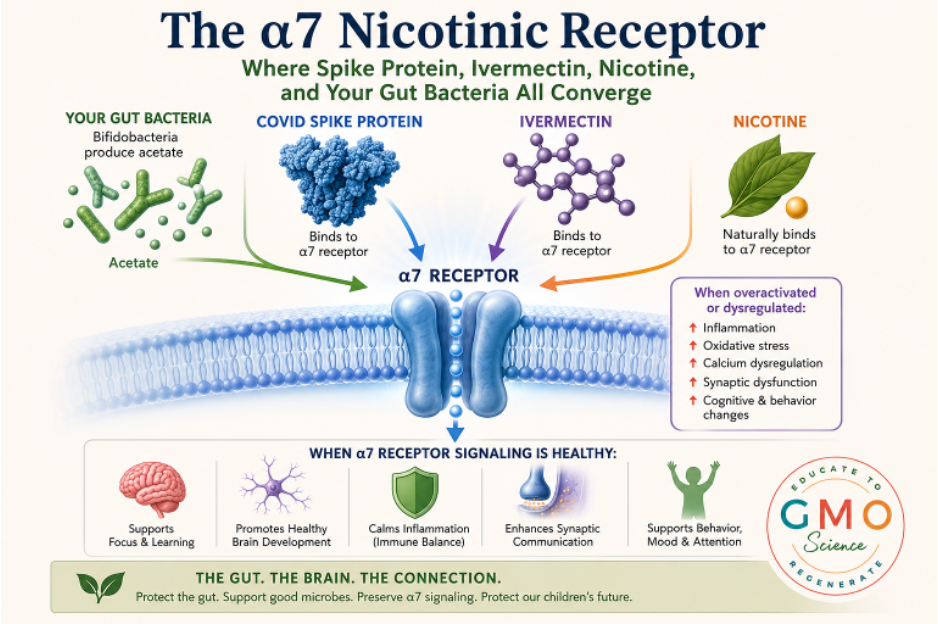
There are many types of acetylcholine receptors. The α7 nicotinic acetylcholine receptor (let’s call it α7nAChR for short, or just the α7 receptor) is one of the most important and one of the most vulnerable.
It’s called “nicotinic” because nicotine from tobacco also fits into it. That’s right. Your body has receptors specifically designed to respond to a plant compound. More on why that matters later.
The α7 receptor is found everywhere that matters.
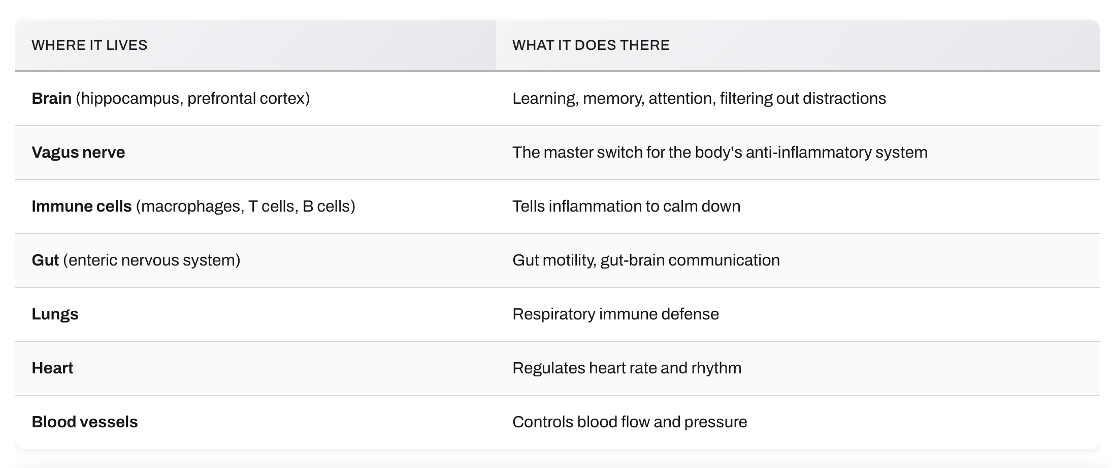
How Your Body Makes Acetylcholine and Where Your Gut Comes In
Your body builds acetylcholine from two ingredients:
- Choline — a nutrient found in eggs, liver, and certain vegetables
- Acetyl-CoA — a molecule made from acetate, which is produced by your gut bacteria
The enzyme choline acetyltransferase puts them together: Acetyl-CoA + Choline → Acetylcholine.
Where does the acetate come from? Your gut bacteria, specifically Bifidobacterium, ferment dietary fiber into short-chain fatty acids, primarily acetate. The acetate crosses into your bloodstream, enters your brain, and gets converted to acetyl-CoA.
No bifidobacteria → no acetate → no acetyl-CoA → no acetylcholine → α7 receptors sit empty.
That’s the gut-brain axis in one metabolic chain. If you read Part I of the series in my substack, you will appreciate that the relationships proposed in that series coupled with this exposé are worth considering. The factors capable of disrupting Bifidobacteria populations could have downstream effects on acetate production, acetylcholine synthesis, and ultimately cholinergic signaling.
Section 2
Evidence That the Spike Protein May Interact with Nicotinic Acetylcholine Receptors
This is the part that sounds like science fiction, but is published, peer-reviewed, and confirmed by multiple independent labs.
The Discovery
In April 2020, French neuroscientists noticed something alarming. When they analyzed the genetic sequence of the SARS-CoV-2 spike protein, they found a region, amino acids Y674 through R685, that looked exactly like snake venom.
Specifically, the spike protein contains a structural motif called a three-finger toxin (3FTx), the same architecture used by:
- α-Bungarotoxin — the paralytic neurotoxin from the banded krait snake
- Cobra toxin — from the king cobra
- Rabies virus glycoprotein — how rabies attacks the nervous system
- HIV gp120 — how HIV binds to immune cells
All of these target nicotinic acetylcholine receptors. Because portions of the spike protein share structural and sequence features with known nicotinic receptor ligands, several investigators have proposed that spike protein may interact with nicotinic acetylcholine receptors. Experimental studies have since provided supportive evidence.
The Confirmation
Multiple labs have now confirmed this is not just a computer prediction and it’s functional:
- Institut Pasteur (Changeux group, 2022): Molecular dynamics simulations showed the spike Y674-R685 region binds the α7 receptor’s agonist binding site which is the exact spot where acetylcholine is supposed to land.
- Journal of Biological Chemistry (Hone & Fenton, 2023): Live-cell imaging confirmed spike protein physically binds α7 receptors on the surface of human neuronal cells. The binding potency is in the nano-molar range meaning tiny amounts produce big effects.
- Molecular Neurobiology (2022): Electrophysiology confirmed that the spike peptide both activates and inhibits α7 receptors. At low doses it stimulates, at higher doses it blocks which is exactly what you’d expect from a neurotoxin.
What This Means in Plain English
The spike protein (whether you’re exposed to it from a COVID infection, passive transmission from a vaccinated individual, or from the mRNA vaccine instructing your cells to produce it) can function as a neurotoxin mimic. It’s shaped like snake venom. It binds the same receptor snake venom binds. It disrupts the same functions snake venom disrupts.
The difference is dose and duration. A snakebite is acute. Vaccine-produced spike protein can circulate for weeks or months, depending on individual factors. The exposure is lower-intensity, but chronic and chronic low-dose neurotoxin exposure produces different symptoms than acute poisoning. Instead of paralysis, you might get brain fog, attention deficits, memory problems, anxiety, and autonomic dysfunction. Sound familiar?
Section 3
How the α7 Receptor Controls Inflammation and What Happens When Spike Blocks It
The Cholinergic Anti-Inflammatory Pathway
Your body has a built-in brake system for inflammation. It’s called the cholinergic anti-inflammatory pathway:
- Your vagus nerve detects inflammation somewhere in the body.
- The vagus nerve releases acetylcholine onto immune cells (macrophages) in the affected tissue.
- The acetylcholine binds α7 receptors on those immune cells.
- The α7 receptor signals the immune cell to stop producing inflammatory cytokines (TNF-α, IL-1β, IL-6).
- Inflammation resolves.
This is one of the most powerful endogenous anti-inflammatory systems in the body. It’s why vagus nerve stimulation is being studied as a treatment for rheumatoid arthritis, Crohn’s disease, and other inflammatory/autoimmune conditions.
What Spike Protein Does to This System
When spike protein occupies the α7 receptor, acetylcholine can’t. The brake pedal is blocked. Immune cells keep pumping out inflammatory cytokines unchecked.
This is the mechanism behind:
- The COVID “cytokine storm”: the hyper-inflammatory state that killed people in ICUs
- Long COVID inflammation: the chronic low-grade immune activation that persists for months or years
- Post-vaccine inflammatory syndromes: the same spike protein, produced by your own cells, can trigger the same receptor blockade
The α7 receptor on immune cells is supposed to be the off-switch for inflammation. Spike protein jams the switch in the “on” position.
What This Means for Your Child’s Brain
The α7 receptor isn’t just on immune cells. It’s throughout the brain especially in the prefrontal cortex (attention, impulse control) and hippocampus (memory, learning). When α7 receptors in the brain are blocked:
- Sensory gating fails: the brain can’t filter out background noise. Every stimulus feels equally important. This is a core feature of ADHD and autism.
- Attention collapses: the prefrontal cortex needs cholinergic signaling to sustain focus. Without it, attention fragments.
- Memory consolidation is impaired: the hippocampus requires α7 activation to convert short-term memory to long-term storage.
- Neuroinflammation increases: α7 receptors on microglia (the brain’s immune cells) normally keep them in a resting state. When blocked, microglia shift to a pro-inflammatory mode, damaging neurons.
The clinical picture, a child who can’t focus, who can’t filter distractions or can’t remember what they just learned, and has a chronically activated immune system maps perfectly onto what you’d expect from α7 receptor dysfunction.
Section 4
Ivermectin: The Receptor Protector
How Ivermectin Works at the α7 Receptor
Ivermectin was never just an antiparasitic. In 1998, a landmark paper in Molecular Pharmacology demonstrated that ivermectin is a positive allosteric modulator (PAM) of the α7 receptor.
Let’s unpack that:
- Positive: It enhances the receptor’s function
- Allosteric: It binds at a different site than acetylcholine (not the keyhole, but a side pocket)
- Modulator: It changes how the receptor responds
When ivermectin is present, the α7 receptor opens more readily when acetylcholine binds. The same amount of acetylcholine produces a stronger signal. The receptor becomes more sensitive and more responsive.
How Ivermectin Blocks Spike Protein
Ivermectin doesn’t just modulate the receptor: it also binds the spike protein directly. Computational docking studies (2021, Structural Chemistry) showed ivermectin binds spike at the ACE2 interface with a binding affinity of −9.0 kcal/mol which is strong enough to physically prevent spike from attaching to cells.
A 2024 study in Viruses added another mechanism: ivermectin binds the N-terminal domain of spike, blocking the very first step of viral attachment to lipid rafts on the cell surface. This mechanism works across all variants such as Wuhan, Delta, Omicron, and KP.3.
The Dual Protection
Ivermectin protects you two ways:
- Receptor-level: It enhances α7 function, making the receptor more responsive to whatever acetylcholine you have.
- Toxin-level: It binds spike protein directly, neutralizing it before it can reach the receptor.
This is why ivermectin worked for COVID. Not because of some vague “antiviral” property, but because it directly counteracts the spike protein’s receptor-level pathology.
Section 5
Nicotine: The Accidental Antidote
The Smoker Paradox
Early in the pandemic, a pattern emerged that epidemiologists couldn’t explain: current smokers were dramatically underrepresented among hospitalized COVID patients. Multiple meta-analyses confirmed this. It was so counterintuitive since smoking damages lungs, so smokers should be worse off that many dismissed it as a data error.
The French neurotoxin discovery could explain it. One proposed explanation for these observations involved competitive interactions at nicotinic acetylcholine receptors. The spike protein couldn’t bind because the parking spot was taken.
How Nicotine Protects the α7 Receptor
Nicotine is an orthosteric agonist at the α7 receptor. That means it binds the exact same site acetylcholine binds which is the keyhole itself. When nicotine occupies that site:
- It activates the receptor (which triggers anti-inflammatory signaling)
- It physically prevents spike protein from binding (competitive antagonism)
The protective effect isn’t from smoking since we know that the tar, carbon monoxide, and combustion products are harmful. It’s from nicotine itself, delivered cleanly. Nicotine patches, gum, or lozenges provide the receptor protection without the lung damage.
The Ardis Protocol
Dr. Bryan Ardis has been the most vocal advocate for nicotine as a therapeutic intervention against spike protein pathology. His position:
- Nicotine saturates α7 receptors, blocking spike protein attachment
- Transdermal patches are preferred because they bypass the gut (where spike-laden nicotine receptors can cause nausea when suddenly activated) and provide steady receptor occupancy
- Consistent dosing matters since you want receptors occupied throughout the day, not just intermittently
- The goal is receptor protection, not addiction; therapeutic nicotine use is fundamentally different from recreational smoking
The Published Support
The NIH-funded study in the Journal of Biological Chemistry (2023) confirmed: “SCoV2P potentiates and inhibits ACh-induced α7 nAChR responses by an allosteric mechanism, with nicotine enhancing these effects.”
Tizabi et al. (2020, FEBS Journal) explicitly proposed nicotine as a COVID therapeutic through α7-mediated anti-inflammatory effects. They noted that ivermectin, as a positive allosteric modulator of α7, could work synergistically with nicotine.
Section 6
The Gut Connection: Where Bifidobacteria Complete the Picture
The Acetylcholine Precursor Pipeline
Here’s the metabolic chain that connects your gut bacteria to your brain function:
- You eat fiber.
- Bifidobacterium in your gut ferments that fiber.
- The fermentation produces acetate; a short-chain fatty acid.
- Acetate crosses into your bloodstream and enters your brain.
- In the brain, acetate is converted to acetyl-CoA.
- Acetyl-CoA combines with choline (from your diet) to make acetylcholine.
- Acetylcholine binds α7 receptors → attention, memory, anti-inflammatory signaling.
No Bifidobacteria → no acetate → no acetyl-CoA → no acetylcholine → α7 receptors sit empty.
The Double Hit
Now look at what could happen to a child:
Hit 1 — Glyphosate: Glyphosate kills Bifidobacterium via the shikimate pathway. The bacteria that should be producing acetate are depleted. Acetylcholine synthesis drops. α7 receptors are starved of their natural ligand.
Hit 2 — Spike Protein: Whether from infection or vaccine, spike protein binds α7 receptors, blocking whatever acetylcholine remains from reaching its target.
The same receptor is being attacked from both directions:
- The key (acetylcholine) isn’t being made because the gut bacteria that supply its precursor are dead.
- The lock (α7 receptor) is jammed by a neurotoxin mimic.
Why This Could Explain the ADHD Epidemic
The α7 receptor is critical for attention. It’s heavily expressed in the prefrontal cortex (the brain region that handles focus, impulse control, and filtering distractions). When α7 function is impaired:
- You can’t sustain attention
- You can’t filter out irrelevant stimuli
- You act impulsively because the “stop and think” circuit isn’t working
- Working memory fails because the hippocampus needs cholinergic input
These predicted consequences overlap substantially with core features observed in ADHD.
The stimulant medications used to treat ADHD (Ritalin, Adderall, Vyvanse) increase dopamine and norepinephrine. They partially compensate for the attention deficit by flooding the brain with arousal signals. But they don’t fix the cholinergic problem. They don’t restore Bifidobacteria. They don’t remove spike protein from α7 receptors. They’re a chemical workaround, not a cure.
Section 7
The Unified Model
Here is the complete picture and the Big Broadway finale: the mechanism that connects industrial agriculture, the pharmaceutical industry, and the explosion in childhood neurodevelopmental disorders:
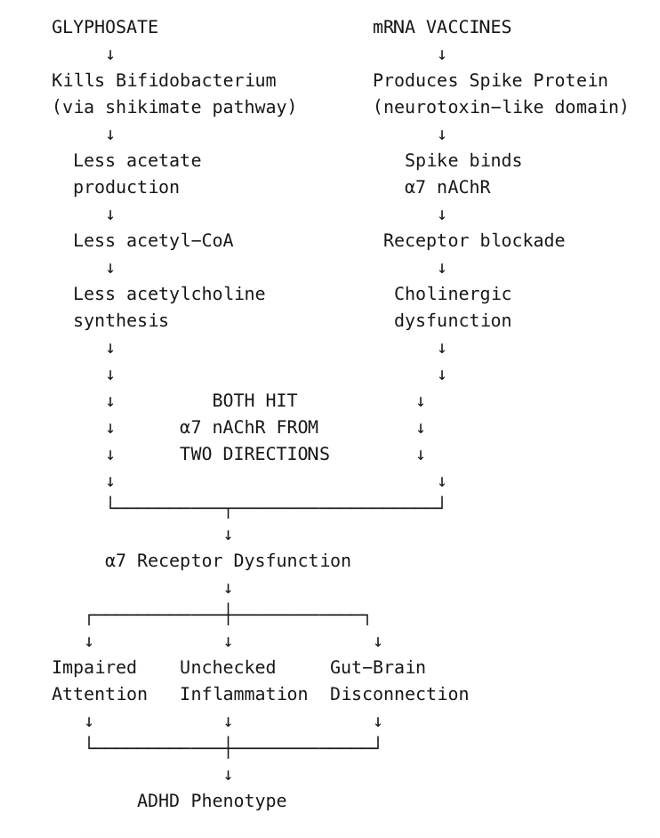
Two independent mechanisms, one destroying the acetylcholine supply chain, one blocking the receptor acetylcholine is supposed to activate, converging on the same molecular target. This is a plausible causal web with multiple independent lines of evidence pointing to the same conclusion.
Clinical Perspective
The hypotheses discussed in this article did not arise solely from reading the literature. They emerged from years of observing children with attention disorders, neurodevelopmental challenges, immune dysregulation, gastrointestinal dysfunction, and increasingly complex chronic illness.
As a clinician, I am repeatedly struck by the convergence of findings involving microbiome disruption, inflammatory activation, altered neurocognitive function, and environmental exposures. While clinical observations cannot establish causation, they often provide the first clues that an important biological mechanism may be operating beneath the surface.
The model presented here should therefore be viewed as a framework for investigation rather than a final conclusion. My hope is that it encourages researchers to examine these relationships more closely and to test them rigorously
Section 8
What You Can Do
If you’ve followed this far, you understand the problem. Here are the levers you can pull:
- Protect Your Gut Bacteria
- Eat organic. Avoid glyphosate residues by choosing organic corn, soy, wheat, oats, and legumes. Glyphosate is used as a desiccant (drying agent) on conventional grains right before harvest; it’s on your food.
- Filter your water. Glyphosate is in groundwater in agricultural regions.
- Support bifidobacteria. Prebiotic fibers (inulin, GOS, FOS), fermented foods, and targeted probiotics containing infantis, B. breve, and B. longum can help restore what’s been lost.
- Consume the products produced by bacteria during fermentation such as fermented foods (contain living microbes and the metabolites they have made)
- Breastfeed when Breast milk contains human milk oligosaccharides (HMOs) that specifically feed B. infantis.
- Protect Your α7 Receptors
- Consider nicotine patches and not smoking nor vaping. Clean nicotine in controlled doses occupies α7 receptors and blocks spike protein binding. This is the Ardis protocol. Consult a knowledgeable practitioner.
- Consider ivermectin as a positive allosteric modulator of α7 and a direct spike protein binder. Both human and veterinary formulations exist; dosing is weight-based. In most states it requires a prescription. Find a doctor who understands the mechanism.
- Nicotine and ivermectin can work synergistically since nicotine occupies the orthosteric site, and ivermectin enhances receptor function from the allosteric site.
- Support Acetylcholine Production
- Eat choline-rich foods: eggs (especially the yolks), beef liver, chicken liver, fish, cruciferous vegetables.
- Consider choline supplements: Alpha-GPC and citicoline cross the blood-brain barrier effectively.
- Support your gut bacteria so they can produce the acetate your brain needs to make acetyl-CoA.
- Reduce Ongoing Exposure
- Rethink the vaccine schedule. If spike protein from any source damages α7 receptor function, each exposure compounds the problem. Space out what you can. Question what’s necessary.
- Avoid additional glyphosate exposure. This is the one exposure you can control most directly through food choices.
The Bottom Line
Your child’s ability to pay attention, control impulses, and regulate inflammation depends on a receptor called α7 nAChR. That receptor may be threatened from two directions: the gut bacteria that supply its natural activator are being killed by glyphosate, and the receptor itself is being blocked by a neurotoxin-like protein produced by COVID vaccines.
The ADHD epidemic is not a mystery. It’s not “better detection.” It’s not screens. It’s a predictable consequence of disrupting the cholinergic system at the molecular level.
The good news: the mechanisms are being unraveled. The interventions exist. Ivermectin, nicotine, and gut microbiome restoration all target the same pathway which are protecting the α7 receptor and restoring acetylcholine signaling. The bad news: your doctor probably doesn’t know any of this, and the institutions that should be investigating it are not providing the research.
You now know more about the α7 receptor than 99% of pediatricians. Use that knowledge.
References
- Hone AJ, Fenton AW, et al. SARS-CoV-2 spike ectodomain targets α7 nicotinic acetylcholine receptors. J Biol Chem. 2023;299(5):104674.
- Lagoumintzis G, et al. Human nicotinic acetylcholine receptors are targets for SARS-CoV-2 spike protein. 2021.
- Changeux JP, et al. A functional interaction between Y674-R685 region of the SARS-CoV-2 spike protein and the human α7 nicotinic receptor. Mol Neurobiol. 2022;59:6076-6090.
- Alexopoulos P, et al. The SARS-CoV-2 virus and the cholinergic system. Int J Mol Sci. 2023;24(6):5597.
- Krause RM, et al. Ivermectin: a positive allosteric effector of the α7 neuronal nicotinic acetylcholine receptor. Mol Pharmacol. 1998;53(2):283-294.
- Fantini J, et al. The binding mechanism of ivermectin and levosalbutamol with spike protein of SARS-CoV-2. Struct Chem. 2021;32:1985-1992.
- Fantini J, et al. Ivermectin binds to the N-terminal domain of the spike protein of SARS-CoV-2 variants. 2024;16(11):1836.
- Tizabi Y, et al. Nicotine and the nicotinic cholinergic system in COVID-19. FEBS J. 2020;287(17):3656-3663.
- Farsalinos K, et al. Nicotine and SARS-CoV-2: COVID-19 may be a disease of the nicotinic cholinergic system.Toxicol Rep. 2020;7:658-663.
- Al-Kuraishy HM, et al. Cholinergic dysfunction in COVID-19. Naunyn-Schmiedeberg’s Arch Pharmacol. 2023;396:453-468.
- Parry PI, et al. ‘Spikeopathy’: COVID-19 spike protein is pathogenic, from both virus and vaccine mRNA. 2023;11(8):2287.
- Bull-Larsen S, et al. The role of the gut microbiome in ADHD. 2019;11(11):2805.
- Stiernborg M, et al. Lower plasma concentrations of short-chain fatty acids (SCFAs) in patients with ADHD. J Psychiatr Res. 2022;156:36-43.