Article 12 in the Got Real Milk Series
A newly published molecular analysis of precision-fermented milk products raises urgent questions regarding pediatric safety, unidentified fungal metabolites, and the growing regulatory vacuum surrounding synthetic biology-derived foods.
We have entered an era in which food is no longer simply grown, raised, or produced traditionally. Increasingly, it is being engineered through synthetic biology labs capable of generating novel proteins and fermentation-derived compounds with minimal, if any, knowledge of their effects on human consumption.
And now, these products are being offered as substitutes for one of the most biologically important foods in childhood: milk.
A newly published study in Scientific Reports serves as a serious warning to regulators, physicians, parents, and public health officials alike. The paper directly challenges one of the central assumptions driving the synthetic milk industry: that these products are substantially equivalent to natural dairy and therefore safe enough to enter the food supply under existing regulatory frameworks.
The findings suggest otherwise.
Researchers conducted detailed molecular analyses of a commercially available synthetic milk product produced by precision fermentation. What they discovered raises alarming concerns not only about these products themselves, but about the regulatory inadequacy that allowed them onto the market with limited independent scrutiny.
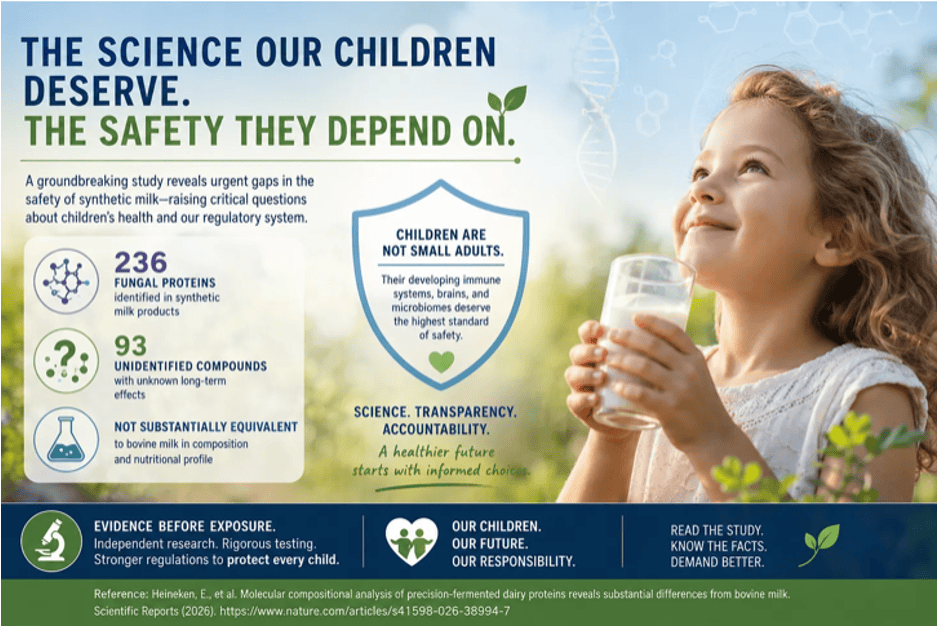
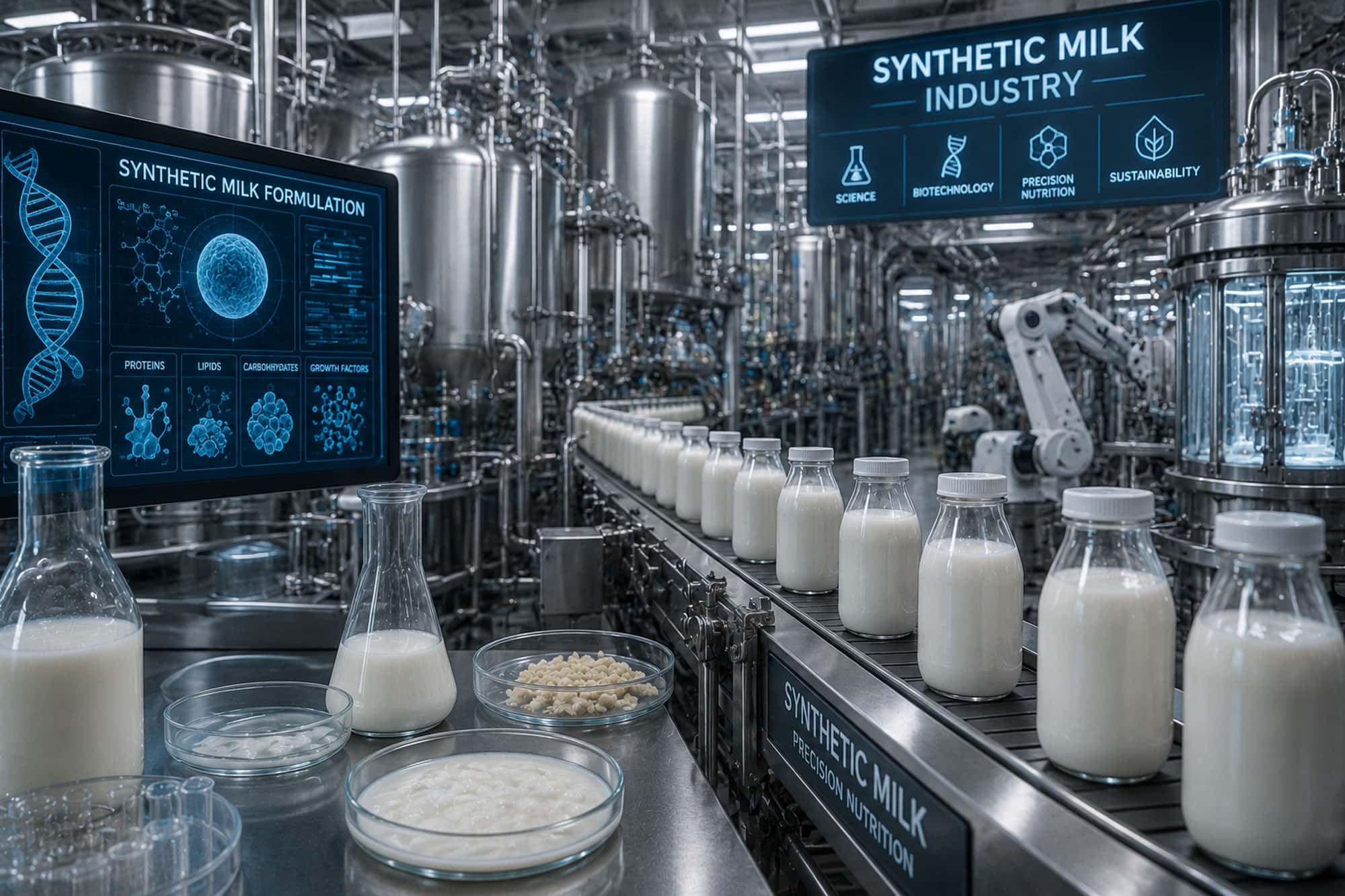
The synthetic milk product analyzed in the study contained 236 fungal proteins and 93 unidentified fungal metabolites. Researchers also found major differences in amino acid composition and nutrient profile when compared to bovine milk. Perhaps most strikingly, the product consisted largely of fungal proteins rather than the singular milk protein consumers are often led to believe they are purchasing.
This is not a trivial finding.
The Illusion of Equivalence
The concept of substantial equivalence has become one of the most consequential assumptions in modern food regulation. If a synthetic product appears nutritionally similar to a conventional food on paper, it is often treated as though it functions biologically the same way in the human body.
But biology does not operate on marketing language or for that matter, like an engineering project.
Small molecular differences may carry significant biological consequences, particularly in developing children whose immune, neurological, endocrine, and metabolic systems are still under construction. The assumption that a synthetic biology-derived product is automatically interchangeable with natural dairy simply because it contains a targeted protein ignores the profound complexity of real food.
This new study directly challenges that assumption.
The molecular composition of the synthetic milk product was not equivalent to bovine milk. The differences were measurable, extensive, and biologically relevant enough to warrant serious scientific and regulatory attention.
A Clinical Lens: Why Fungal Metabolites Matter
Certain fungal metabolites are already known to exert profound biological effects in humans, even at very low concentrations. Mycotoxins such as ochratoxin A, aflatoxins, and trichothecenes have been associated with immune dysregulation, mitochondrial injury, endocrine disruption, neurotoxicity, gut barrier impairment, and carcinogenicity.
Importantly, the unidentified compounds found in this study were not themselves identified as established mycotoxins. However, their presence highlights the basic principle that fungal-derived metabolites may exert biologically significant effects that warrant extensive safety evaluation prior to widespread dietary exposure.
This concern becomes especially important in pediatrics.
Children are not mini adults.
Infants and children possess immature detoxification pathways, developing immune systems, and highly sensitive neurological and endocrine networks. Early childhood nutrition is not merely caloric intake; it is biological instruction. Every exposure during infancy helps shape immune tolerance, microbiome development, neuroendocrine signaling, metabolic function, and inflammatory response patterns that may persist throughout life.
What happens when developing children are repeatedly exposed to dozens of unidentified metabolites and hundreds of novel fungal proteins that have not undergone long-term pediatric safety evaluation?
The honest scientific answer is that we do not yet know.
And that uncertainty alone should demand far greater caution than we are currently seeing from regulators and industry alike.
GRAS Was Never Designed for Synthetic Biology
In medicine, we do not introduce a novel biologic into infants and children without years of toxicology, allergenicity, developmental, immunologic, reproductive, and longitudinal safety testing. Yet, synthetic biology-derived food products are now entering grocery stores under a regulatory framework that frequently allows corporations to determine safety largely on their own.
This framework is known as GRAS: Generally Recognized As Safe.
To the average consumer, GRAS sounds reassuring. In reality, the modern GRAS system has evolved into something far different from what the public assumes it to be. Companies may self-affirm safety determinations for novel food substances without requiring extensive independent pre-market review by the FDA. While some manufacturers voluntarily notify the agency, many ingredients can enter the food supply through industry-led safety conclusions rather than rigorous long-term human testing.
That system was never designed for an era of synthetic biology.
It was not designed for genetically engineered microorganisms producing novel proteins. It was not designed for precision fermentation platforms generating compounds with limited histories of human consumption. And it was certainly not designed for products aimed at children during the most biologically vulnerable windows of their development.
Public Relations Is Moving Faster Than Toxicology
The precautionary principle exists for a reason. When widespread exposure could affect vulnerable populations, especially infants and children, the burden of proof must rest on demonstrating safety before commercialization and not after the public has already become exposed.
Unfortunately, the opposite is now occurring.
Synthetic biology companies are fast-tracking products into the food system under the guise of sustainability, innovation, and climate solutions while fundamental biological safety questions remain unaddressed. Public relations campaigns are moving faster than toxicology. Regulatory oversight is lagging behind technological capability. And once again, children risk becoming unwitting participants in a large-scale nutritional experiment.
This issue extends far beyond milk.
We are witnessing the rapid normalization of genetically engineered microorganisms throughout the food supply: engineered yeasts, fungi, bacteria, and fermentation-derived compounds designed to replace traditional foods. These technologies are advancing far more rapidly than independent long-term safety science. At the same time, regulators continue relying upon outdated assumptions of equivalence that may no longer apply in the age of synthetic biology.
An Immediate Call for Action
At a minimum, these findings warrant:
- An immediate independent review of synthetic milk products marketed toward children
- Mandatory long-term toxicology and allergenicity testing
- Developmental and reproductive safety studies
- Microbiome impact assessments
- Transparent labeling requirements
- A temporary suspension of GRAS determinations for synthetic biology-derived food products until comprehensive reevaluation occurs.
Consumers cannot provide informed consent when the science itself is not transparent and incomplete.
As a pediatrician who has spent over four decades caring for increasingly chronically ill children, I view this study through a clinical lens that is impossible to ignore. We are already witnessing unprecedented rates of immune dysregulation, food sensitivities, neurodevelopmental disorders, inflammatory disease, metabolic dysfunction, and microbiome disruption in children. Against this backdrop, introducing poorly characterized synthetic food systems into early childhood nutrition without robust and honest independent safety science is not precautionary medicine. It is regulatory recklessness.
The question is no longer whether synthetic biology will transform the food supply.
The question is whether society will demand meaningful safety science before these technologies are normalized in children’s diets.
Food should nourish development, not become an uncontrolled biological experiment conducted in real time on the next generation.
For more information on children and milk products, including GMOScience’s infant formula toxic metal investigations, please visit the series at Got REAL Milk?
Reference
Heineken, E., et al. “Molecular compositional analysis of precision-fermented dairy proteins reveals substantial differences from bovine milk.” Scientific Reports (2026). Springer Nature,
Scientific Reports Study.