
As Artificial Intelligence Expands Across America, Are We Asking the Right Public Health Questions?
As a pediatrician, I have spent more than four decades watching children become collateral damage in environmental experiments that were declared safe before adequate study was performed.
GMOs/pesticides. Leaded gasoline. Secondhand tobacco smoke. PFAS. Ultra-processed foods. Geoengineering. And the list goes on.
In each case, the infrastructure arrived first. The children paid later.
Today, we are witnessing another infrastructure boom. Under the banner of artificial intelligence, hundreds of massive data centers are being proposed across the United States. The public conversation focuses on economic development, technological innovation, and global competitiveness.
Missing almost entirely is a discussion of children’s health.
That omission is unacceptable.
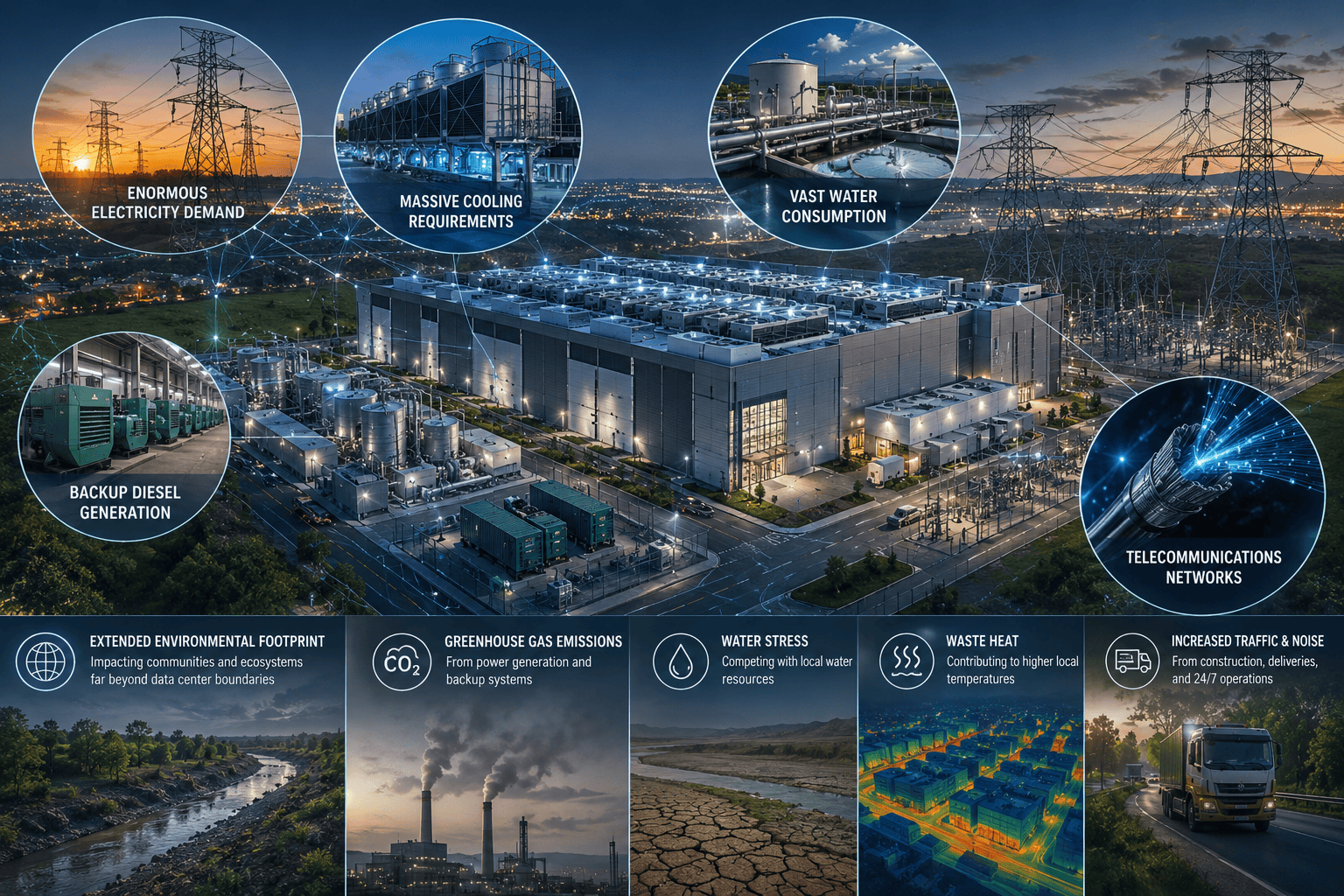
Data centers are not benign warehouses filled with computers. They are industrial-scale facilities requiring enormous quantities of electricity, water, cooling systems, backup diesel generation, transmission infrastructure, artificial lighting, and telecommunications networks. Their environmental footprint extends far beyond their property lines.
Children will bear the greatest burden of these decisions because children are uniquely vulnerable to environmental exposures. They breathe more air per pound of body weight, consume more water relative to their size, have developing neurological and immune systems, and will live the longest with the consequences of today’s policy choices.
In my view, the rapid expansion of data centers should be paused until comprehensive pediatric health assessments are conducted. Public health history has repeatedly shown that waiting for definitive proof after widespread deployment is a dangerous strategy when children’s health is at stake.
The Air Our Children Breathe
Among all environmental threats to children, air pollution remains the leading cause of environmentally related disease and death worldwide. The World Health Organization estimates that hundreds of thousands of children under five die annually from diseases linked to polluted air.
Data centers contribute to this burden in two ways: Firstly, nearly all large facilities rely upon fleets of diesel backup generators. These generators are tested regularly and deployed during power interruptions and periods of grid stress. Diesel combustion releases fine particulate matter (PM2.5), nitrogen oxides (NOx), and other pollutants known to contribute to asthma, impaired lung development, respiratory infections, cardiovascular disease, and adverse neurodevelopmental outcomes.
Secondly, the electricity required to power data centers often originates from fossil fuel generation. As artificial intelligence drives demand for increasingly large computing facilities, upstream emissions from coal and natural gas generation become part of the health equation.
Children are especially vulnerable because their lungs are still developing and they inhale significantly more air per pound of body weight than adults. Damage sustained during childhood may persist for a lifetime.
The AI revolution may be digital, but the pollution it generates is profoundly physical.
The Noise We Cannot Escape
Environmental noise is frequently overlooked in discussions of children’s health.
Data centers operate continuously. Massive cooling systems, pumps, ventilation systems, transformers, and backup infrastructure generate noise twenty-four hours a day, seven days a week.
Research examining chronic environmental noise exposure in children has linked elevated noise levels to impaired reading comprehension, reduced academic performance, concentration difficulties, sleep disruption, increased stress responses, and adverse cognitive outcomes.
Unlike a passing airplane or temporary construction project, data centers are designed for perpetual operation. Communities do not receive occasional noise; they inherit permanent noise.
For children, sleep is not a luxury. It is a biological requirement for brain development, immune regulation, learning, emotional stability, and growth.
The possibility that thousands of children could spend their formative years exposed to chronic industrial noise deserves far greater scrutiny than it currently receives.
Water: The Forgotten Pediatric Resource
Every individual understands the importance of clean water.
Yet, data centers are rapidly becoming some of the largest consumers of municipal and groundwater resources in many communities.
Modern facilities require enormous volumes of water for cooling. National projections suggest data center water consumption could increase dramatically over the next decade as artificial intelligence expands.
Water allocation is not merely an engineering issue. It is a children’s health issue. When aquifers decline, drought conditions worsen, municipal systems become strained, and communities face water restrictions, children experience the consequences first and longest.
The question is no longer whether data centers consume water. The question is whether communities have adequately considered what this means for future generations.
The Expanding Web of Infrastructure
Data centers rarely arrive alone. They require substations, transformer banks, transmission corridors, telecommunications networks, security lighting, and increasingly complex wireless infrastructure.
This raises additional questions involving chronic light exposure, electromagnetic fields, and cumulative environmental stressors.
Artificial light at night has been associated with circadian disruption, altered melatonin production, sleep disturbances, metabolic dysfunction, and behavioral effects. Healthy sleep is essential for childhood development.
Similarly, expansion of high-voltage electrical infrastructure inevitably increases environmental electromagnetic field exposure. Multiple pooled analyses have reported associations between elevated magnetic field exposure and childhood leukemia, leading the International Agency for Research on Cancer to classify extremely low-frequency magnetic fields as a possible human carcinogen.
Debate continues regarding causality and mechanisms. However, debate should not be confused with reassurance.
Children today may become the first generation raised amid an unprecedented combination of wireless technologies, electrical infrastructure, industrial computing systems, chronic artificial illumination, environmental noise, and increasing air pollution burdens.
No comprehensive pediatric assessment has evaluated these cumulative exposures.
That fact alone should concern us. We have been here before.
Public health history is filled with examples of industries assuring the public that concerns were premature, speculative, or unsupported. GMOs and their associated pesticides, tobacco, lead, asbestos, EMFs, and countless environmental contaminants followed a familiar trajectory: widespread adoption first, recognition of harm later.
The central question is not whether every possible risk associated with data centers has been conclusively proven.
The central question is whether children deserve protection while we find out.
Artificial intelligence may ultimately offer meaningful benefits to medicine, education, and society. However, public health history reveals that technological advancement and precautionary evaluation must proceed together, particularly when children bear the greatest potential risks.
Until comprehensive pediatric health assessments are conducted, the precautionary principle demands that continued large-scale expansion of data centers warrants not only serious reconsideration, but an immediate moratorium until the impact of these developments on our children’s health are seriously investigated. Some decisions are too permanent, and children are too important, to get wrong.
NOTE: The author advocates for a precautionary approach to large-scale data center expansion until comprehensive pediatric health assessments are conducted.
GMOScience is a 501c3 nonprofit committed to the well-being of our children and our environment; educate to regenerate. Please make a tax-deductible donation to support our mission.
REFERENCES
- World Health Organization. Air Pollution and Child Health: Prescribing Clean Air. Geneva, Switzerland: World Health Organization; 2018.
- Pan E, Johnston J, Caylor K, et al. Artificial intelligence and the public health costs of data centers: estimating air pollution related health impacts of AI driven electricity demand. Front Clim. 2026;8:1648912.
- Stansfeld SA, Berglund B, Clark C, Lopez-Barrio I, Fischer P, Öhrström E, et al. Aircraft and road traffic noise and children’s cognition and health: a cross national study. Lancet. 2005;365(9475):1942-1949.
- Chepesiuk R. Missing the dark: health effects of light pollution. Environ Health Perspect. 2009;117(1):A20-A27.
- Ahlbom A, Day N, Feychting M, Roman E, Skinner J, Dockerty J, et al. A pooled analysis of magnetic fields and childhood leukaemia. Br J Cancer. 2000;83(5):692-698.
- International Agency for Research on Cancer. Static and Extremely Low Frequency Electric and Magnetic Fields. IARC Monographs on the Evaluation of Carcinogenic Risks to Humans. Vol. 80. Lyon, France: International Agency for Research on Cancer; 2002.